explainer · cobalt
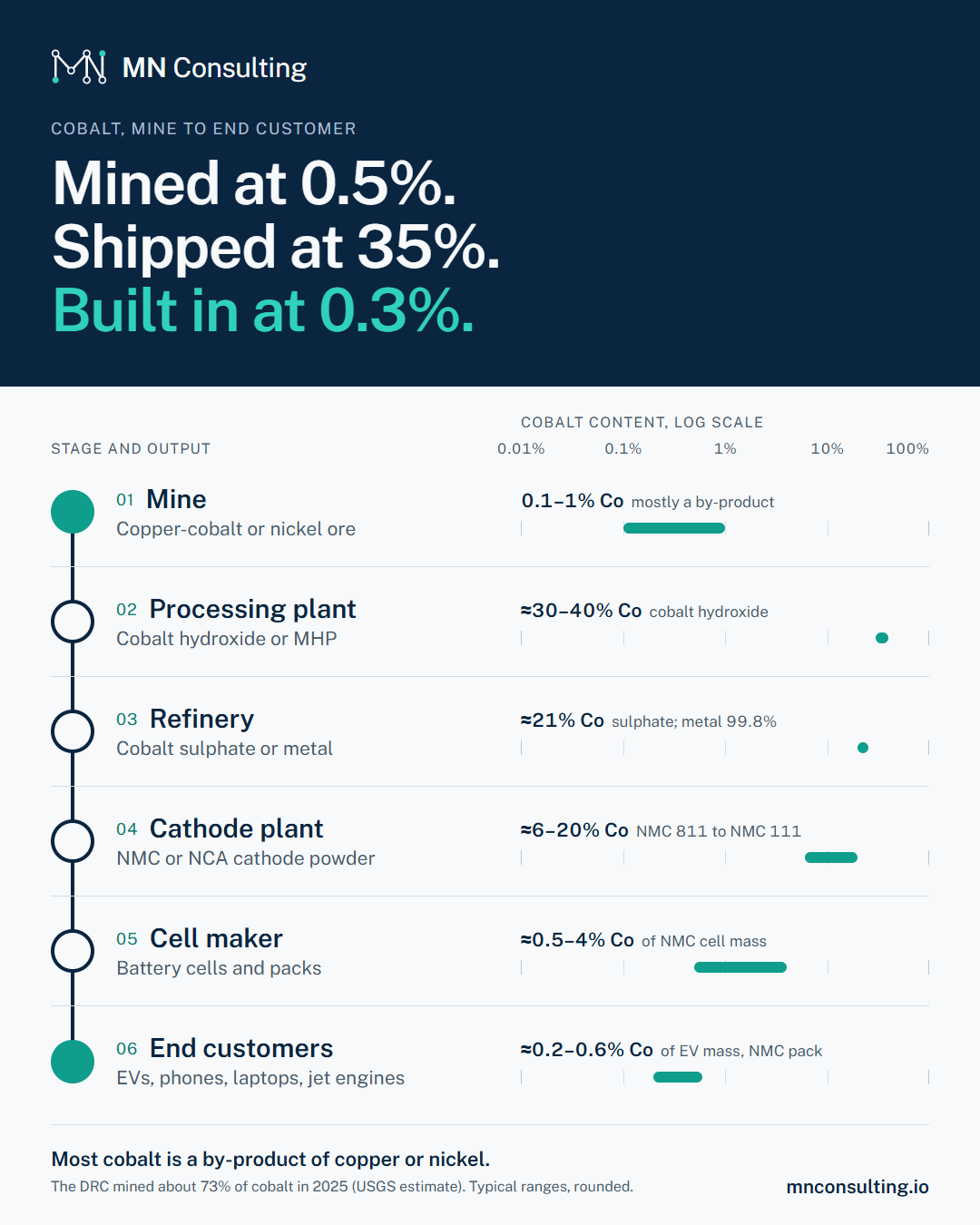
Mined at 0.5%. Shipped at 35%. Built in at 0.3%.
Cobalt is mostly a by-product of copper and nickel. It leaves the DRC as hydroxide, is refined in China, and ends up in battery cathodes and alloys. Due diligence questions follow it the whole way.
6 stages
Six stages, from Copperbelt mine to end product
Select a stage to see what happens there, who does it, and which record moves with the material. The bars show cobalt content by mass on a log scale.
Cobalt content is shown as elemental cobalt (Co) by mass.
scale
Where cobalt comes from
of cobalt was mined in 2025. USGS Mineral Commodity Summaries 2026, 2025 estimate
of mined cobalt came from the Democratic Republic of the Congo. USGS Mineral Commodity Summaries 2026, 2025 estimate
came from Indonesia, as a by-product of nickel laterite processing. USGS Mineral Commodity Summaries 2026, our calculation, 2025 estimate
a year is the DRC's cobalt export quota for 2026 and 2027. USGS Mineral Commodity Summaries 2026, 2026–27
traceability
Where the record usually breaks
- Before exportHydroxide from several mines, and in some cases artisanal ore bought through traders, can be combined into one lot before it leaves the DRC.
- At the refineryRefiners blend hydroxide and MHP from many sources. Audits check the refiner's process, not the origin of each batch.
- At the cell makerOne cell draws on cathode lots from several suppliers, so the battery passport needs lot links from the refinery onward.
Our traceability rollouts link these records, from mine lot to finished product, so a claim about origin holds up when a customer or regulator asks for it.
Planning a traceability rollout, or one that has stalled after the pilot? Book a 30-minute call.
share
The whole chain on one image
A 1080 × 1350 image of the 6 stages, sized for LinkedIn. Free to share with a link back to this page.
Sources
Production figures are USGS estimates for 2025. Stage ranges are typical industry values, rounded, not data for a specific plant.