guide
Pilot to scale-up: why traceability rollouts stall, and the go-live checklist
I wrote this for the operating companies rolling out traceability: miners, refiners, metals and battery companies and OEMs. It is for the project sponsor and the internal teams who have to make it work, including traceability, sustainability, procurement, supply-chain, data and IT leads.
The platform is bought. The pilot ran. It is not live across your sites and suppliers. The technology is usually not the reason. The reasons are people, incentives and preparation, and most of them are visible before you start.
This page covers why rollouts stall, the warning signs, the data blueprint, the first 90 days, and the one thing to do before you sign. The PDF is a 17-page workbook: seven steps from pilot to scale-up, three checkpoints to tick off before you move on, six fill-in templates and a glossary of upstream terms. The one-pager below puts it all in 16 steps on a single page.
Get the guide
A 17-page PDF workbook: seven steps, three checkpoints, six fill-in templates and a glossary. Leave your name and email and I will email you the PDF.
If it does not start, download the guide.
in short
Why do traceability rollouts stall after the pilot?
Mostly because the project rests on one person or one team. The person who asks for the pilot is often not the one who will hold the budget for the scale-up, and no one has the scale-up on their KPIs, so no one is incentivised to make it work. Ask early who will hold the budget for full implementation, and involve them from the start.
What are the warning signs before a traceability rollout starts?
No change management plan for the internal stakeholders, and no supplier engagement, acknowledgement or approval to take part. For an internal project, such as a miner tracing material through its own operations, that is change management and incentive alignment. For a global supply chain, such as an OEM tracing material back through its suppliers, do not assume suppliers will comply because you are the customer. Do the pre-engagement work first.
What goes into a traceability data blueprint?
Four questions, answered with the people who own the data in the business, not only IT: what data is needed, which systems it sits in, how it will be extracted, and whether it can be pulled into a central repository. The answers show what you have and where the gaps are. Then give each site and supplier the exact data points you need and why, in the language they already use: tonnes, grade, assays and contained metal.
What should happen in the first 90 days of a rollout?
Choose where to start, find which sites and suppliers are willing to engage, and show momentum internally. Option A is friendly, engaged sites first, to build momentum. Option B is one hard site first, to learn the roadblocks before you replicate, at the cost of more early friction and a slower time to value. Sharing early progress builds confidence and some healthy FOMO across sites.
What should a sponsor do before signing for a traceability platform?
Align the incentives of the teams who have to deliver it. Put traceability explicitly into their annual balanced scorecards, with team-specific targets, for example a supplier-engagement target for procurement.
The 16 steps on the one-pager
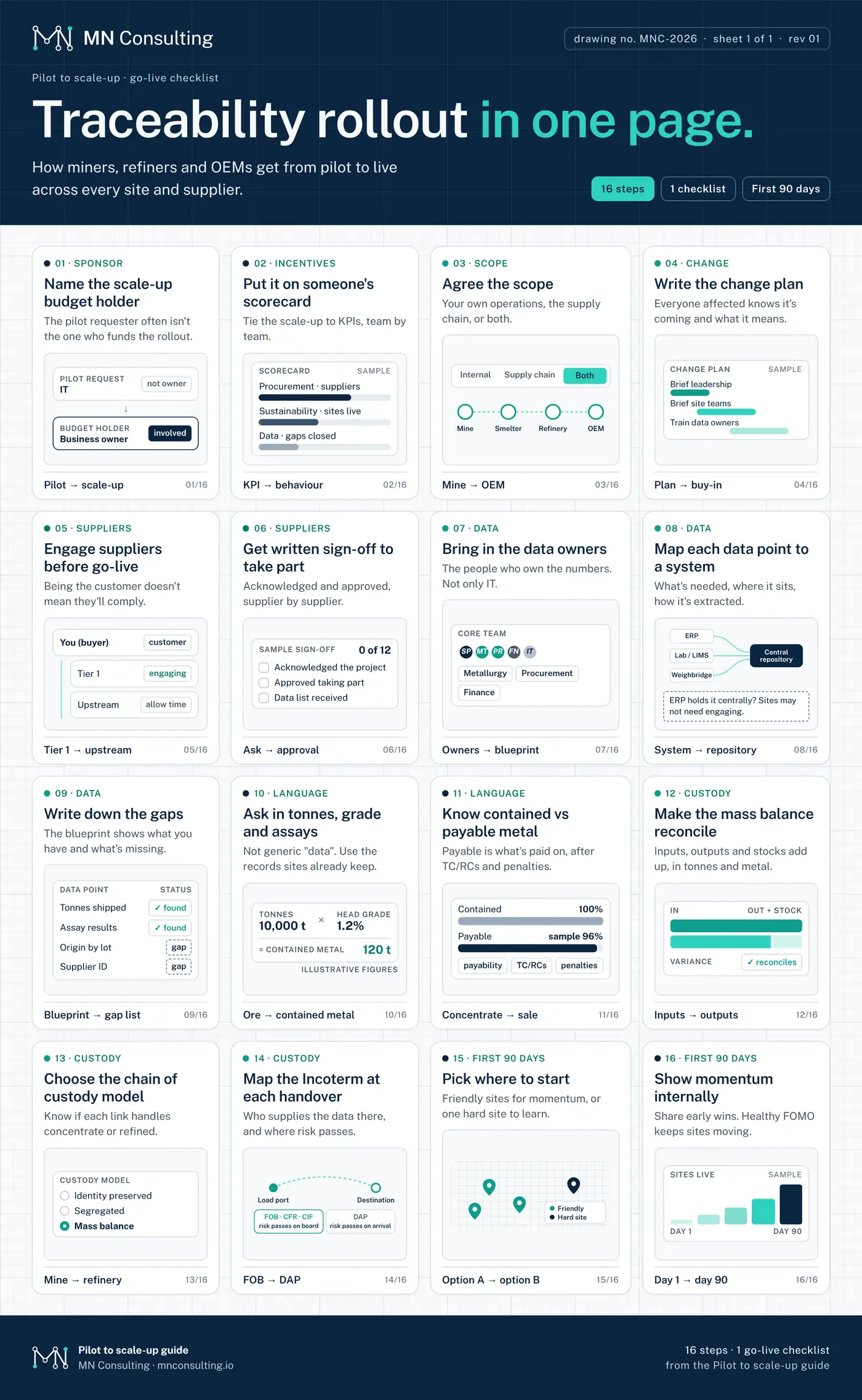
The same steps as the one-pager above, as text.
- Sponsor Name the scale-up budget holder. The pilot requester often is not the one who funds the rollout.
- Incentives Put it on someone's scorecard. Tie the scale-up to KPIs, team by team.
- Scope Agree the scope. Your own operations, the supply chain, or both.
- Change Write the change plan. Everyone affected knows it is coming and what it means.
- Suppliers Engage suppliers before go-live. Being the customer does not mean they will comply.
- Suppliers Get written sign-off to take part. Acknowledged and approved, supplier by supplier.
- Data Bring in the data owners. The people who own the numbers, not only IT.
- Data Map each data point to a system. What is needed, where it sits, how it is extracted.
- Data Write down the gaps. The blueprint shows what you have and what is missing.
- Language Ask in tonnes, grade and assays. Not generic “data”. Use the records sites already keep.
- Language Know contained vs payable metal. Payable is what is paid on, after TC/RCs and penalties.
- Custody Make the mass balance reconcile. Inputs, outputs and stocks add up, in tonnes and metal.
- Custody Choose the chain of custody model. Know if each link handles concentrate or refined product.
- Custody Map the Incoterm at each handover. Who supplies the data there, and where risk passes.
- First 90 days Pick where to start. Friendly sites for momentum, or one hard site to learn.
- First 90 days Show momentum internally. Share early wins. Healthy FOMO keeps sites moving.
Key terms
Terms that come up when you ask sites and suppliers for traceability data.
- Contained metal
- The quantity of metal inside a given amount of ore, concentrate or product. Roughly tonnes multiplied by grade.
- Payable metal
- The share of contained metal a buyer pays for under the sales contract, after payability terms, treatment and refining charges (TC/RCs) and any impurity penalties. It is what the producer gets paid on.
- Assays
- Laboratory analyses of samples that measure grade and impurities. They underpin contained metal figures and, at sale, payable metal and penalties.
- Mass balance
- Accounting for material into and out of a site or process (tonnes and contained metal), so inputs, outputs and stocks reconcile. In traceability it is also the name of a chain of custody model where certified and non-certified material can be mixed but tracked by quantity.
- Chain of custody
- The documented record of who held the material as it moved from mine to processor to manufacturer, and the model used to link claims to it (for example identity preserved, segregated or mass balance).
- Concentrate versus refined product
- Concentrate is the upgraded mineral product from a mine's processing plant. Refined product is the high-purity output of a smelter or refinery. Each has different data, specifications and paperwork.
- Cost per tonne
- The unit cost of the operation (per tonne mined, moved or processed). It is how sites manage their cost base.
- Incoterms (FOB, CFR, CIF, DAP)
- The ICC's Incoterms® 2020 rules named in the sales contract. They set where delivery happens and where costs and risk pass from seller to buyer. Under FOB, CFR and CIF, risk passes once the goods are on board the vessel at the port of shipment (under CFR and CIF the seller still pays freight, and under CIF insurance, to the destination port). Under DAP, the seller carries risk until the goods arrive at the named destination. For chain of custody, the Incoterm shows where each handover happens, and so who has to supply the data and documents at that point. Incoterms do not cover ownership: when title passes is set by the sales contract, and it can be a different point (for example on payment).
The full guide is a 17-page PDF workbook: seven steps, three checkpoints, six fill-in templates and a glossary of upstream terms. Get the guide.
If you are a miner, refiner or OEM planning a traceability rollout, or one that has stalled after the pilot in your operations or supply chain, I am happy to talk it through. Book a 30-minute call.