explainer · graphite
Mined at 10%. Purified to 99.95%. Built in at 3%.
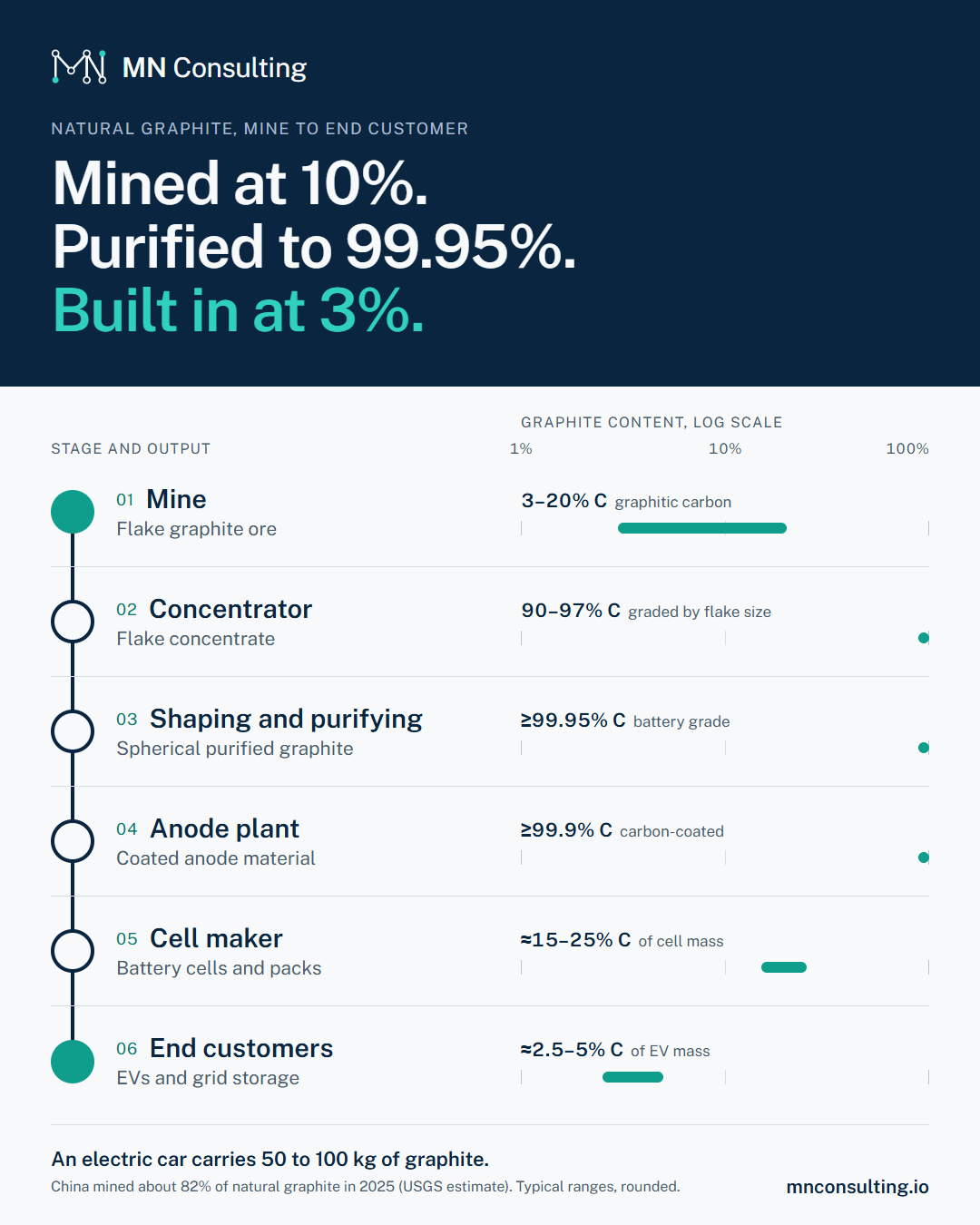
Natural graphite is mined at around 10%, floated to a concentrate, then shaped and purified to 99.95% for battery anodes. That last step happens almost entirely in China, and natural and synthetic graphite are often blended along the way.
6 stages
Six stages, from flake mine to electric car
Select a stage to see what happens there, who does it, and which record moves with the material. The bars show graphite content by mass on a log scale.
Graphite content is shown as graphitic carbon (C) by mass. The page covers natural flake graphite; synthetic graphite made from petroleum coke joins at the anode stage.
scale
Where natural graphite comes from
of natural graphite was mined in 2025. USGS Mineral Commodity Summaries 2026, 2025 estimate
of mined natural graphite came from China. USGS Mineral Commodity Summaries 2026, 2025 estimate
came from Madagascar, Tanzania and Mozambique combined. USGS Mineral Commodity Summaries 2026, our calculation, 2025 estimate
preliminary US anti-dumping duty on anode material from China. USGS Mineral Commodity Summaries 2026, 2025
traceability
Where the record usually breaks
- At the purifierSpherical graphite plants take concentrate from several mines and countries. Few keep the mass balance that ties output to a mine.
- At the anode plantNatural and synthetic graphite are blended to tune performance. The blend ratio is the record buyers most often lack.
- At the end customerTariffs and tax credits now depend on where anode material came from, so missing records now cost money as well as reputation.
Our traceability rollouts link these records, from mine lot to finished product, so a claim about origin holds up when a customer or regulator asks for it.
Planning a traceability rollout, or one that has stalled after the pilot? Book a 30-minute call.
share
The whole chain on one image
A 1080 × 1350 image of the 6 stages, sized for LinkedIn. Free to share with a link back to this page.
Sources
Production figures are USGS estimates for 2025. Stage ranges are typical industry values, rounded, not data for a specific plant.